

Breast Augmentation
What Is Dual Plane Breast Augmentation?
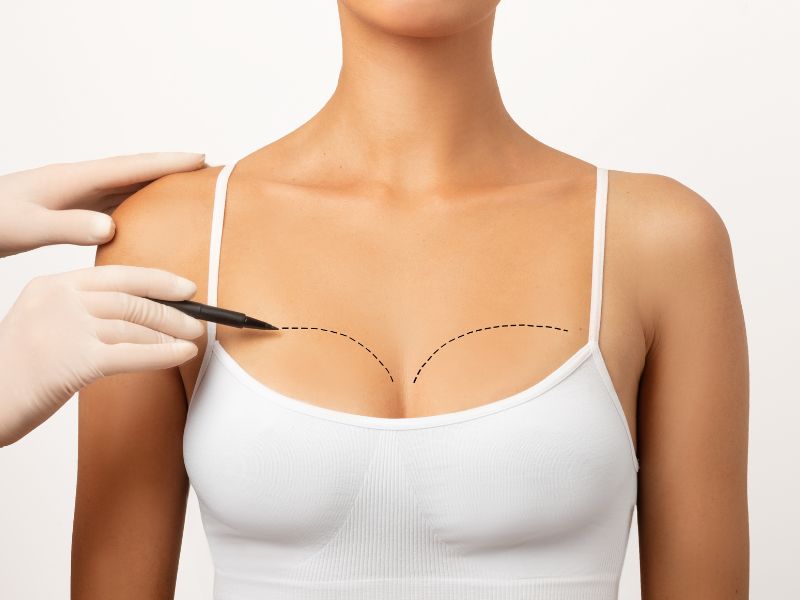
Breast implant placement plays an important role in determining how natural your final result appears and how well it holds up over time. Among today’s advanced approaches, dual plane breast augmentation is widely chosen because it allows the implant to work with your anatomy rather than against it.
If you are searching for dual plane breast augmentation, you may have noticed that it is often recommended for women who want a softer upper breast contour without compromising lower breast fullness. By combining the stability of under-muscle placement with the shaping advantages of over-muscle positioning, the dual plane technique offers a balanced, refined outcome when carefully planned.
In this blog, you will learn about the dual plane breast augmentation technique, its key benefits, the typical recovery process, how it compares to submuscular and subglandular placement, and who may be a suitable candidate for this approach.
What is dual plane breast augmentation?
Dual plane breast augmentation is an implant placement method where the implant sits in two different tissue “planes”:
The pectoralis major muscle covers the upper portion of the implant.
The lower portion of the implant is positioned under the breast tissue, with less muscle coverage, allowing it to shape the lower breast.
This is why people also call it dual plane breast implants placement or “partial submuscular” placement. It is neither fully submuscular nor fully subglandular.
A commonly referenced approach is Dual Plane Pocket I, an advanced technique associated with Dr John Tebbetts, where a targeted release of the lower muscle attachments helps the implant settle without being overly compressed by the muscle.
How does dual plane breast augmentation work?
A straightforward way to picture how a dual plane breast augmentation works is how different tissues are placed:
Muscle coverage at the top helps soften the implant edge and reduce a sharp “step” in the upper breast, especially in slimmer patients.
Breast tissue coverage at the bottom region allows the implant to expand the lower breast more freely, supporting a smoother curve and better lower-pole fullness.
In Dual Plane I concepts, the surgeon selectively releases some of the lower pectoral attachments (often described as those around the lower rib attachments) to create space for the implant and reduce unwanted pressure. The goal is to create a pocket that supports the implant without trapping it.
Dual plane breast augmentation benefits
The dual plane breast augmentation benefits relate to shape, coverage, and function:
More natural upper breast contour
The muscle covers the upper implant edge, which can reduce a visible ridge in the upper pole.
Better lower pole fill and a softer curve
Because the lower implant is less restricted by muscle, it can help create a more natural, rounded base.
Useful for mild sagging in selected patients
Dual plane placement can be helpful when there is mild ptosis or “in-between” anatomy where the implant needs to support the lower breast more effectively.
Lower risk profile compared with fully subglandular in some patients
With more tissue coverage over the implant in the upper portion, some patients may have fewer visible edges and rippling.
Reduced implant distortion with chest movement compared with a fully submuscular placement
Because the implant is not entirely under the muscle, movement-related distortion may be less pronounced than full submuscular placement in some instances.
Dual plane breast augmentation vs submuscular
When patients compare dual plane breast augmentation vs submuscular, the differences usually come down to comfort, movement, and how the implant shapes the breast:
Full submuscular (under the muscle): This approach provides more muscle coverage, which can be beneficial for patients with fragile tissue. Still, it may limit the implant’s ability to shape the lower breast. It may also increase the chance of noticeable movement when the pectoral muscles contract in some people.
Dual plane: Keeps upper coverage while allowing the lower implant to shape the breast more freely. It is often chosen when the aim is a natural upper slope plus better lower pole projection.
A practical takeaway: Dual plane can be a middle ground when a patient wants the concealment benefits of under-muscle placement but does not want the lower breast to look tight or under-filled.
Dual plane vs subglandular breast augmentation
A comparison of dual plane versus subglandular breast augmentation often focuses on soft tissue coverage and long-term appearance.
Subglandular (over the muscle): The implant sits between the breast tissue and the muscle. It can involve a simpler pocket and may feel easier in the early recovery phase because the muscle is not being manipulated as much. However, in thin patients, implant edges and rippling can be more visible because there is less coverage.
Dual plane: Adds muscle coverage in the upper part, which can help create a smoother upper contour and provide extra coverage where many patients first notice implant edges.
Neither option is “best” for everyone. The right pocket depends on your breast tissue thickness, skin quality, chest anatomy, and your goals.
Who is a good candidate for dual plane breast augmentation?
If you seek who is a good candidate for dual plane breast augmentation, the following profiles often benefit:
Women with limited upper breast tissue who want a softer transition in the upper pole
Patients with mild to moderate breast sagging, where lower pole fill matters
Patients who want a balanced look with natural upper slope with good lower curve
Women concerned about visible implant edges with over-the-muscle placement, especially if they have thin soft tissue
A consultation and physical assessment are essential because the choice of implant (shape, size, profile) and pocket choice work together.
When patients compare dual plane breast augmentation vs submuscular, the differences usually come down to comfort, movement, and how the implant shapes the breast:
Full submuscular (under the muscle): This approach provides more muscle coverage, which can be beneficial for patients with fragile tissue. Still, it may limit the implant’s ability to shape the lower breast. It may also increase the chance of noticeable movement when the pectoral muscles contract in some people.
Dual plane: Keeps upper coverage while allowing the lower implant to shape the breast more freely. It is often chosen when the aim is a natural upper slope plus better lower pole projection.
A practical takeaway: Dual plane can be a middle ground when a patient wants the concealment benefits of under-muscle placement but does not want the lower breast to look tight or under-filled.
Dual plane breast augmentation recovery: what to expect
Dual-plane breast augmentation recovery varies, but it typically involves some tightness across the chest initially, as the muscle is engaged.
Many patients notice:
First week: Appearance of swelling, pressure, and limited arm movement; rest and support garments matter.
Weeks 2 to 6: Gradual easing of tightness; return to light daily activity as advised.
After 6 weeks: Many people return to fuller exercise routines, depending on healing and surgeon guidance.
Recovery is not only about time. It is also about how carefully you follow aftercare, how your tissues respond, and whether any additional procedures were performed.
Dual plane breast augmentation complications
All surgery has some or the other risk. Dual plane breast augmentation complications usually cover the broader implant-surgery risks, plus a few placement-specific considerations.
Possible issues can include:
Capsular contracture (scar tissue tightening around the implant)
Implant malposition (implant sitting too high, too low, or shifting)
Visible rippling (more likely with thin tissue or confident implant choices)
Implant distortion with muscle contraction (animation deformity), typically less than full submuscular in many cases, but still possible
General surgical risks such as infection, bleeding, fluid collections, delayed healing, or scarring concerns.
It all depends on the surgeon’s planning, pocket technique, implant selection, and aftercare guidance all affect risk.
Dual plane breast augmentation before and after: what changes are realistic?
When patients search for dual plane breast augmentation before and after, they are usually looking for two improvements:
A smoother upper breast contour, without a sharp implant edge
A better lower breast curve, so the implant looks like it belongs to the body
The most natural-looking outcomes happen when sizing matches your chest width, skin quality, and lifestyle. A good plan also includes a clear discussion of what an implant can and cannot correct. For example, significant sagging may require a lift rather than relying solely on an implant pocket.
Why Choose Dr Faisal Salim for Dual Plane Breast Augmentation?
Condition-led surgical planning
Dr Faisal assesses your breast anatomy, tissue quality, and lifestyle before recommending implant placement, rather than using a one-size-fits-all approach.Advanced expertise in breast surgery
With extensive experience in breast augmentation techniques, including dual plane placement, his focus is on balanced proportions and long-term outcomes.Precision-focused technique
Careful pocket creation and implant positioning are prioritised to reduce visible edges, distortion, and avoid unnecessary muscle trauma.Patient safety and transparency
Every consultation includes an honest discussion of benefits, limitations, recovery expectations, and potential risks, so decisions are well informed.Personalised care from consultation to recovery
From your first assessment to post-operative follow-up, treatment is tailored to your needs, comfort, and aesthetic goals, ensuring continuity of care.
Let’s Plan Your Breast Augmentation the Right Way
Dr Faisal Salim offers a condition-led, personalised approach to breast surgery, focusing on careful assessment, tailored planning, and patient safety from consultation through recovery.
If you are considering dual plane breast augmentation and want advice based on your anatomy and goals, you can book a consultation with Dr Faisal and his team at B-SPOKE by Dr Faisal in Dubai.
FAQs
It is a placement method where the top of the implant sits under the chest muscle, and the bottom sits under the breast tissue, providing muscle coverage above and a softer, more natural shaping below.
By allowing the lower implant to sit under the breast tissue, it can fill the lower breast more naturally, which may help alleviate mild droop. It is not a replacement for a breast lift when sagging is more significant.
Some tightness and discomfort are familiar in theirst week because the muscle is involved. Most patients improve steadily over the following weeks with appropriate aftercare.
Risks include capsular contracture, implant shift, rippling, and possible distortion related to muscle movement. General surgical risks also apply.
Many patients find the dual plane looks more natural in the lower breast because the implant is less restricted there, while still keeping upper coverage from the muscle.



Patient Testimonials